

The Vedic (Sound) Civilization
The Indus Valley Civilization (IVC), contemporaneous with the world’s earliest civilizations (circa 3300–1300 BC), was defined by urban planning, sophisticated drainage systems, extensive and peaceful trade networks. Farmers and herders were primary inhabitants who grew wheat and barley. Minimal evidence of weapons or warfare as well as a focus on a Mother Goddess or Shiva-like figure are reported. Environmental factors such as changing river courses and, potentially, reduced monsoon activity are reported to have caused its decline around 1900 BC [1].
The Vedic Civilization (VC, circa 1500–500 BC) succeeded the IVC. Veda in Sanskrit means knowledge. Despite making lasting contributions such as developing the science of language, Vedas, concept of deep meditation, and rituals for about four thousand years, the VC has remained relatively unknown. Vedic religion was polytheistic and pantheistic (regarding the universe as divine). Members worshipped forces of nature such as fire, the sun, stars, the moon, the earth, wind, sky, trees, rivers and mountains. For example, Indra is the god of rain and storm, and Agni is the goddess of fire. It laid the groundwork for the current Hindu way of life, including concepts of Dharma (way of life), Karma (actions), and Moksha (liberation). Rig Veda’s Creation Hymn gave precedence to the Universe because gods and religion came after the birth of the Universe. The VC broke with the civilizational protocol and developed unique scientific approaches relevant to the needs of an oral society and achieved unusual success [2]. For example, it developed the science of human speech-sounds which was the foundation of VC. Decimal math, binary math, combinatorics, and yoga are some examples of disciplines that owe their birth and development to VC [3]. It started with a group of seers (with supernatural insight to foresee the future) who went into deep and long meditation and discovered certain Truths in the Universe. The seers then are supposed to have revealed Truths to the members in the form of unique sound vibrations. The revealed part is known as the Shruti literature and exists today in the form of four Vedas: The Rig Veda, Yajur Veda, Sāma Veda, and Atharva Veda [2]. In response to what was revealed to them, at about the 5th BC, members of the VC developed six Vedāgas – limbs of the Vedas. They are: Nirukta (etymology), Vedānga Jyotisha (astronomy/math), Śikşa (phonetics), Vyākaraņa (grammar), prosody or chandas (poetic meter), and Kalpa (rituals) [2]. Note that four of the six limbs are related to language. The six Vedāngas are part of the smruti literature (related to what is heard) and functioned as the blueprint for building the VC. The Vedic people, characterized by passion for Shiksha – the science of phonetics, started gathering in small groups called shākhās or geographic branches. Each branch of Veda developed its own Prātishākhya, a composition on phonetics (shiksha), grammar (vyakarana), and chandas (prosody) and provided rules for pronunciation, intonation, and the correct articulation of Vedic mantras. Grammar of the spoken language formed the basis of this science and was referred to as a foundational science [2, 4].
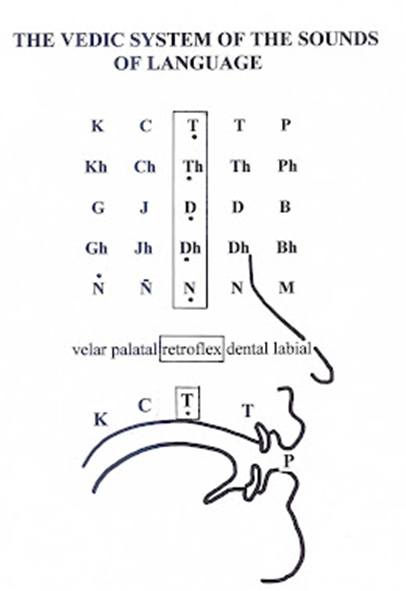
The reciters of the Vedas made a major discovery: they found that the consonants of a language are produced by constricting the vocal tract at a particular point along its stationary portion – the palate or upper lip [2, 4]. If we move from the larynx or throat to the lips, we pronounce ka, ca, ṭa, ta, pa. Each of these syllables may be unvoiced or voiced, provided with varying amounts of breath, which may be made to pass through the nasal cavity as well. Thus, we produce, in the case of ka, the sequence ka, kha, ga, gha, ṅa; and similarly for the other four consonantal stops. The two directions are combined in the two-dimensional square or varga that is depicted in Figure 1 [5-8]. To complete the picture, a few other syllables must be added along with semi-vowels and vowels.The Sanskrit language uses syllables called the Aksharas. The groupings of the sounds based on phonetic principles (“one sound one symbol”) was the achievement of the priests of the Vedic times and originated with the Pratishakhya tradition [5-8]. This 5 x 5 square formed the basis of the science of linguistics and led to the Brahmi script, the mother of all scripts in India and some in the Far East. The Brahmi script is based on human speech-sounds and their respective locations within the larynx. This ingenious plan helped create communication as well as to fulfill the desires of an oral society to preserve and maintain the unique sounds of the Vedas, with minimum ambiguities. Two ingenious ways were created to save and archive the knowledge built: designating families as repositories of knowledge and the Guru – Shishya Parampara (the tradition of passing on knowledge to the disciples) [2]. Unique techniques were developed for memorizing compositions. This lasted more than a thousand years and all the knowledge and concepts built have been saved ‘true to the last syllable.’
Panini’s Shiva Sutras are 14 short verses containing all Sanskrit phonemes that enabled thousands of grammatical rules to be packed into just 4,000 aphorisms [9]. They group sounds in a way that aligns with the physiology of speech production and are essential for understanding how to derive Sanskrit words. They are considered the foundation of human speech, grouping 57 distinct sounds that can be produced by the human vocal cord. Mendeleyev, who was working on the development of the periodic table, was highly influenced by the Vedic 5 x 5 varga (square) (see Figure 1) as well as Panini’s Shiva sutras. He is known to have named the yet undiscovered but predicted new elements with Sanskrit prefixes of ēka, dvi etc. (meaning one, two, etc. in Sanskrit respectively) in homage to Panini. Later, these elements turned out to be Aluminum and Manganese respectively [9, 10].
The philosophical concept of Shabda Brahman, which means sound is supreme or transcendental, was introduced to stress the importance of sound as a reliable communication medium. This helped them explain metaphysical truths through words (which were sounds in oral days). Vyakarana, which ensured that the truths of the Vedic Rishis remained available to all in a pristine form, has led to major treatises in the language. It is even today actively pursued field of study [4]. Soon after six schools of philosophy were developed in India, a clear and unique format was developed for ‘Open Discourse’ or Vāda [11]. The ancient School of Nyāya and open debate (Vāda)“extended over a period of one thousand years, beginning with Gotama about 550 BC and ending with Vātsāyana about 400 AD” [12]. The main goal of Indian logic was to acquire valid knowledge through perception and inference [11- 13].
Along with the introduction of vāda, assemblies or councils of people started to form. They were called sabhā, samiti, or parishad. The Rig Vēda stated that one could not rule without a samiti. The Indian epics such as Arthashāstra, Rāmāyaņa, the Mahābhārata, and Ashţādhyāyi have all made use of these concepts [11]. After independence, democratic India’s Constitution created two houses of Parliament: an Upper House (the Rājya sabhā) and a Lower House (the Loka sabhā), thus reviving the old Sanskrit word sabha and infusing it with new meaning.
With limitations of oral communications in mind, the Sūtra style of composition was developed to archive knowledge in highly condensed form. It made use of the knowledge gained from philosophy, language, and logic. The notions of rule, metarule (paribhasha in Sanskrit, meaning a rule about rules), and of rule order (order of priority of rules) were developed. In the Srauta Sūtra, Apastamba has enumerated and prioritized the default options for oblations, priests, and implements. He has also clarified the notion of degrees of default. Paņini developed his own meta-language suited for composing his monograph on Sanskrit grammar, The Ashtādhyāyi [14]. Using metarules and rule order, the ritual and grammatical systems express recursiveness, that is, they describe an infinite domain of facts with the help of a finite number of rules. Introduction of strict grammatical and phonetic rules made the Sanskrit language scientific and thereby signaled the beginning of human science. [6-8]. The Sanskrit grammar and rules helped create one universal science out of four different prätisäkhyas on which Patanjali was to comment that “this science is a Prätisäkhya for all the Vedas” [15]. Both grammar and mathematics seek order by looking for suitable rules. The Hindu mathematicians made use of this insight in developing the logic of decimal math.
Some of the above rules, metarules, and default options were successfully employed in developing rules of interpretation in using herbal medicines and appear in the ancient medical encyclopedias of Charaka, Sushrūta and Bhela [see, for example, [16]. By default, herbs should be fresh, not dried, and fresh herbs should be used in double the specified measure. The above-mentioned encyclopedias as well as the treatises on Hindu mathematics were taken to the House of Wisdom [17]. The Ayurvedic treatises, such as the toxicological tract, which is embedded in Susruta’s Kalpasthāna, became famous in Arabic translations from a very early period.
Summary
True to its name, the VC built the science of language first and used it to save almost all the knowledge that had been built. Vedas are repositories of early “sciences” while the Vedāngas have worked as blueprints for building the VC. The philosophical aspects have emphasized universal concepts of karma, reincarnation, and the search for the Absolute (Brāhman/Ătman). Vedic thought shows a shift from outer, ritualistic sacrifices to inner, meditative ones (Dhyana). Invocation of grammar unified the Vedic language, helped introduce default options in ancient Indian medicine, and helped Mendeleyev create the ‘grammar of elements.’ By introducing the profound concept of vāda (open debate) which requires pluralism and openness for its success, VC has contributed to the legacy of democratic ideas in India. Staal has wondered what would have happened to ‘the clumsy alphabets’ around the world if the sound pattern of Sanskrit had reached the Arabs and Europeans at the time Hindu math reached the Arab scholars in the eighth century AD [6].
An upcoming article will focus on how linguistic concepts played a key role in the birth and development of decimal math during the early stages of VC.
Acknowledgements
I am thankful to the Rochester Hills Public Library’s MelCat division for opportunity to borrow books on interlibrary loan. My niece Sheetal drew the figure used for which I am grateful to her.
References
- E. Mackay, Indus Valley Civilization, Lovat Dickson and Thompson, London (1935).
- K. S. Krishnan, Origin of Vedas, Notion Press, Chennai, India (2019); see also, F. Staal, Discovering the Vedas: Origins, Mantras, Rituals, Insights, Penguin (2008).
- J. Bandekar, The Birth and Development of Universal Decimal System (in preparation).
- F. Staal, Editor, A Reader on the Sanskrit Grammarians, The MIT Press, Cambridge, MA (1972).
- H. Scharfe, Panini’s Metalanguage, American Philosophical Society, (1971).
- F. Staal, The Sound Pattern of Sanskrit in Asia, An Unheralded Contribution by Indian Brahmans and Buddhist Monks, University of California, Berkeley (2008).
- M. Monier-Williams, A Sanskrit-English Dictionary (2021), p. xxviii.
- D. D. Mahulkar, Studies in English and linguistics, University of Bombay (1972).
- R. Chaudhri, The Shiva Sutras, Fingerprint! Publishing (2019).
- A. Ghosh and P. Kiparsky, The Grammar of the Elements, American Scientist 107 (2019), pp 350-355.
- R. Tripathy, Vāda in Theory and Practice, DKPrintworld, New Delhi (2016).
- S. Vidyabhusana, A History of Indian Logic, Motilal Banarsidass, Delhi (1920), p 5.
- P. Adamson and J. Ganeri, Editors, Classical Indian Philosophy, A History of Philosophy without any Gaps, Volume 5, Oxford University Press, Oxford (2020), p 3.
- S. C. Vasu, The Ashtādhyāyi of Pāņini (2024).
- S. Dasgupta, Patanjali’s Mahābhāsya (1991).
- D. Wujastyk, The Science of Medicine, in Hinduism, G. Flood, Editor, Blackwell Publishing, Malden, MA (2005), pp. 393-409.
- F. Staal, The Science of Language, in Hinduism, G. Flood, Editor, Blackwell Publishing, Malden, MA (2005), pp. 348-359.
