The Quantum Zeno Effect: From Paradox to Control
Classical Observation and Quantum Measurement
In classical physics, observation plays a passive role. A moving object continues to move whether or not it is observed. Measurement merely reveals what is already happening, without altering the course of events. This intuition is deeply rooted in everyday experience. Quantum mechanics departs sharply from this picture. According to the theory, a physical system is always described by a definite state, and when left undisturbed this state evolves smoothly and predictably in time. This evolution is governed by the Schrödinger equation, which plays a role in quantum mechanics similar to that of Newton’s second law of motion in classical mechanics: given the initial state, it determines how the system changes with time. At the same time, quantum mechanics also contains a second rule, emphasized by von Neumann, according to which a measurement is fundamentally different from ordinary time evolution. When a measurement is made, the smooth evolution is interrupted, and the state of the system is abruptly reduced to one of the possible outcomes allowed by the measurement. Thus, quantum mechanics involves two distinct modes of change: continuous evolution and sudden reduction.
The interplay between these two basic postulates leads to an interesting phenomenon known as the Quantum Zeno Effect. It was introduced by Baidyanath Misra and E. C. G. Sudarshan [1], who posed a simple but profound question: What does quantum mechanics predict when a system subjected to an interaction is repeatedly checked to see whether it has changed its state?
The Quantum Zeno Paradox
The term ‘Zeno’ alludes to Zeno of Elea, a pre-Socratic Greek philosopher (c. 490 – 430 BC) known for his paradoxes that challenge the very notion of motion. In one such paradox, the motion of a flying arrow appears to be arrested when it is examined as a succession of instants, rather than as a continuous process. In an analogous quantum setting, Misra and Sudarshan observed that frequent checking can inhibit the change of a quantum state. They described this as a paradox because measurements are usually expected to induce change by reducing the state, whereas their analysis showed that sufficiently frequent measurements could instead prevent the very change they were meant to detect. For this reason, they originally referred to the phenomenon as the Quantum Zeno Paradox. With time, as its physical content and experimental relevance became clearer, it became known more commonly as the Quantum Zeno Effect.
Misra and Sudarshan’s analysis focused on how a quantum system departs from its initial state over very short intervals of time. In the usual treatment of quantum transitions, when a system interacts continuously over long times, perturbation theory leads to Fermi’s golden rule, according to which transition probabilities grow linearly with time, particularly when the final states form a continuum. In systems with a few discrete levels, exact solutions instead lead to coherent oscillations, known as Rabi oscillations, in which population periodically moves between states. In both cases, the interaction is allowed to act uninterrupted for times long compared to the system’s intrinsic timescales.
Short-Time Quantum Evolution
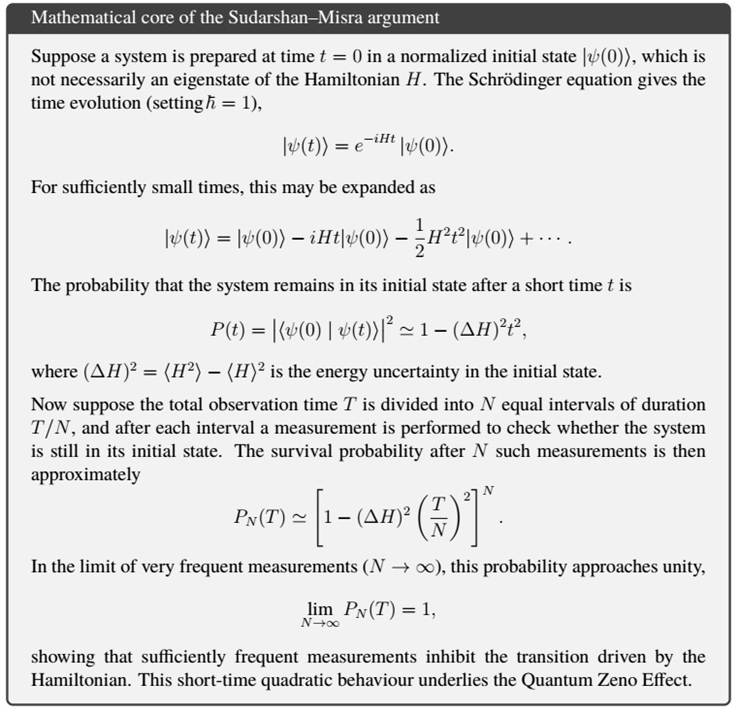
Misra and Sudarshan considered a different regime altogether. They examined what happens when the evolution is interrupted repeatedly at very short intervals. Quantum mechanics predicts that at such short times the probability for a system to leave its initial state grows not linearly, but quadratically with time. As a result, the tendency of the system to change is extremely weak over sufficiently small intervals. When this short-time behavior is combined with very frequent checking, the cumulative effect is a strong inhibition of evolution. In the idealized limit of infinitely frequent measurements, the system remains arbitrarily close to its initial state. In their original work [1], Misra and Sudarshan formulated this reasoning using the density matrix framework, which is well suited for describing measurement processes and statistical ensembles. For clarity and simplicity, however, we present below the essential mathematical core of their argument using the state-vector language, as discussed in later historical and expository accounts and in modern treatments of the subject [2, 3]. This approach captures the central physical idea and makes clear the origin of the Quantum Zeno Effect.
Experimental Evidence
For many years, the Quantum Zeno Effect was regarded as subtle and difficult to observe experimentally. The requirement of very frequent intervention raised doubts about whether the effect could be realized in practice. These doubts were eventually resolved through experiments on well-controlled quantum systems. One important class of experiments involved systems that exhibit coherent transfer between quantum states. In the absence of intervention, such systems undergo smooth and predictable evolution, with population transferring from one state to another. When frequent interventions were introduced to check whether the system had departed from its initial state, this coherent transfer was found to be significantly reduced [4]. As the frequency of intervention increased, the suppression became more pronounced, in qualitative agreement with the predictions of Misra and Sudarshan. These experiments established that the Quantum Zeno Effect is not merely a formal consequence of the theory, but a physically realizable phenomenon.
From Paradox to Control
Experimental developments also made it clear that the effect need not be restricted to the survival of a single quantum state. In many situations, interventions distinguish not between individual states, but between entire sets of states. When transitions between such sets are suppressed, the system becomes confined to a particular region of its state space. Within this region, however, coherent evolution may continue. This leads to the concept of Quantum Zeno subspaces, and to the broader notion of Quantum Zeno dynamics [5], in which evolution is constrained rather than frozen. From this viewpoint, the Quantum Zeno Effect is understood as a restriction on the allowed directions of evolution, rather than a complete arrest of motion.
Subsequent work showed that repeated measurements are only one way of producing such constrained dynamics. Similar effects can be achieved through rapid external control operations, often described as rapid unitary interventions, or through strong continuous coupling between the system and an auxiliary degree of freedom [6]. Although these mechanisms differ physically, they lead to the same outcome: transitions between certain states or subspaces are suppressed. With the benefit of hindsight, it has become clear that several early experimental demonstrations of the Quantum Zeno Effect, including those based on the suppression of coherent transfer, are more naturally understood in terms of rapid unitary interventions rather than ideal projective measurements. What these experiments nevertheless established beyond doubt was the central insight of Misra and Sudarshan: sufficiently frequent intervention can profoundly alter quantum evolution.
Quantum Anti-Zeno Effect
An important refinement of this picture is the recognition of the Quantum Anti-Zeno Effect, first identified and named in earlier work and later placed on a clear physical footing [7,8]. Under certain conditions, frequent intervention can accelerate, rather than inhibit, transitions. Whether inhibition or acceleration occurs depends on the timescale of the intervention relative to the intrinsic dynamics of the system. Very frequent interventions probe the short-time regime and suppress change, while interventions applied at slightly longer intervals can enhance effective transition rates. The Quantum Zeno Effect and the Anti-Zeno Effect thus represent two complementary regimes of the same underlying physics.
Outlook
Since its introduction by Misra and Sudarshan, the Quantum Zeno Effect has evolved from a foundational paradox into a broad framework for understanding and controlling quantum dynamics. The recognition of Zeno subspaces, the development of multiple modes of intervention, and the identification of the Anti-Zeno Effect have all contributed to a deeper and more unified picture. Beyond its foundational significance, Quantum Zeno dynamics has found relevance in modern quantum technologies, where controlled confinement of evolution can be used to protect quantum states and engineer desired dynamics. In this way, the original insight of Misra and Sudarshan continues to inspire new directions, linking fundamental questions to practical possibilities and shaping our understanding of quantum evolution under constraint.
References:
- B. Misra and E. C. G. Sudarshan, Zeno’s paradox in quantum theory, Journal of Mathematical Physics, 18, 756-763, (1977)
- N. Mukunda, The life and work of E. C. George Sudarshan, Resonance, 24, 129-167 (2019).
- P. Facchi, S. Pascazio, The geometry of the Quantum Zeno effect, International Journal of Geometric Methods in Modern Physics, 9, 1260024, (2012)
- W. M. Itano, D. J. Heinzen, J. J. Bollinger, and D. J. Wineland, Quantum Zeno effect, Physical Review A, 41, 2295-2300, (1990).
- P. Facchi, G. Marmo and S. Pascazio, Quantum Zeno dynamics and Quantum Zeno subspaces, Journal of Physics: Conference Series, 196, 012017, (2009).
- P. Facchi and S. Pascazio, Quantum Zeno dynamics induced by strong continuous coupling, Physical Review A, 65, 012108, (2001).
- B. Kaulakys and V. Gontis, Quantum Anti-Zeno effect, Physical Review A, 56, 1131–1139 (1997).
- A. G. Kofman and G. Kurizki, Acceleration of quantum decay processes by frequent observations, Nature, 405, 546-550, (2000).